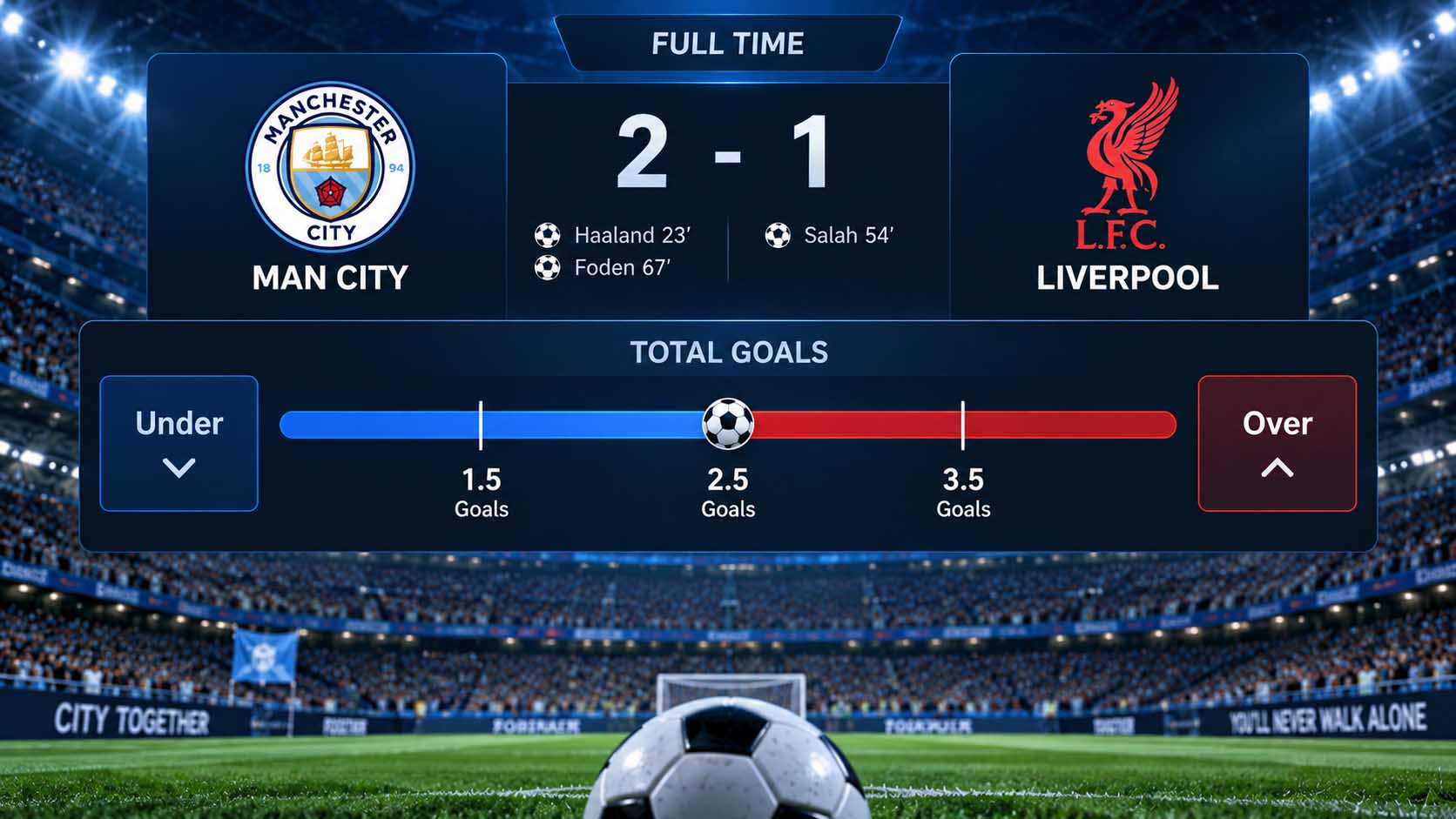
Football over under markets evaluate whether a defined statistic, most commonly the total number of goals, finishes above or below a specified line. Unlike a match-result market, the main question is not which team wins. Instead, the market compares the final relevant total with a numerical threshold such as 1.5, 2.5, or 3.5.
This makes over/under one of the clearest examples of a totals-based football market. Understanding the line, the statistic being measured, and the applicable match period is essential for reading it correctly.
What Are Football Over Under Markets?
An over/under market contains a numerical line and two opposing directions: Over and Under.
Consider a market based on total match goals with a line of 2.5.
Over 2.5 goals means the relevant total must exceed 2.5.
Under 2.5 goals means the total must remain below 2.5.
Since football goals occur in whole numbers, the practical dividing point is straightforward. Zero, one, or two total goals fall below 2.5, while three or more total goals exceed it.
The market can therefore be understood as a comparison:
Measured total → Market line → Over or Under
The Winning Team Does Not Determine the Total
One useful way to understand totals is to compare different scorelines.
Suppose these three matches finish:
2–1
1–2
3–0
Each match has a different relationship between the two teams, yet every scoreline contains exactly three total goals.
Against a 2.5-goal line, all three totals sit above the threshold.
Now consider:
1–0
0–1
1–1
Each contains fewer than three total goals, so each falls below 2.5.
This demonstrates why an over/under market should not be confused with predicting the home team, away team, or draw.
Why Are Lines Such as 2.5 Used?
Half-goal lines create a clear boundary because a completed football match cannot contain half a goal.
With a 2.5 total, the result cannot land exactly on the line.
The possibilities are simply:
0 goals → Under 2.5
1 goal → Under 2.5
2 goals → Under 2.5
3 goals → Over 2.5
4 goals → Over 2.5
The same logic applies to other half-goal totals.
For example, a 3.5 line separates totals of three or fewer goals from totals of four or more.
Whole-Goal Lines Work Differently
Not every totals market uses a half number. A line may sometimes be displayed as a whole value, such as 2.0 or 3.0.
This introduces another possibility: the final total can equal the market line.
For instance, three total goals can land exactly on a 3.0 line. The applicable settlement rules then become important.
Readers should therefore avoid treating Over 3.0 and Over 3.5 as interchangeable. Even though the numbers look similar, they establish different conditions.
Checking the exact market line is always more useful than relying only on the words “Over” or “Under.”
Over/Under Markets Can Measure More Than Goals
Total goals are a familiar example, but the broader over/under structure can be applied to other measurable match statistics when such markets are offered.
The same conceptual framework remains:
- Identify what is being measured.
- Find the numerical line.
- Determine whether the selection is Over or Under.
- Check the relevant settlement period and conditions.
Therefore, seeing a number such as 4.5 is not enough to understand a market. A reader must also know whether the figure refers to goals or another specified statistic.
How Over/Under Differs From 1X2
The easiest distinction concerns the question each market asks.
A 1X2 market focuses on the match result: home win, draw, or away win.
An over/under market focuses on whether a defined total finishes above or below its line.
Imagine a match ends 2–2.
The 1X2 outcome is a draw.
The total number of goals is four.
For a 2.5-goal market, four goals are above the line. For a 4.5-goal market, the same four goals are below the line.
One match can therefore produce different outcomes across several market categories because each market measures something different.
Reading the Market Before Reading the Odds
A useful habit is to understand the market conditions Football over under markets before looking at its odds.
For a football total, first identify the measured statistic. Then read the numerical threshold and confirm whether the selection is Over or Under.
Only after those details are clear should the associated odds be interpreted.
Football-oriented platforms can organize numerous market types around the same fixture. When examining examples such as Linkbola.net, recognizing whether a panel represents totals, match results, handicaps, or another market helps place the displayed information in the correct context.
The market definition explains what must happen. The odds are attached to that defined outcome rather than replacing its meaning.
Over/Under vs Asian Handicap
Both market types frequently display positive or numerical values, but their purposes differ.
Over/under compares a measured total against a threshold.
Asian handicap applies a numerical adjustment to teams for market-settlement purposes.
For example, Over 2.5 goals concerns the number of goals associated with the defined total. A -0.5 handicap concerns an adjustment attached to a particular team.
A quick distinction is:
Totals → How many?
Handicap → What adjustment applies to the team?
Understanding what the number represents prevents confusion between these market formats.
What Does Over 2.5 Goals Mean?
Over 2.5 goals means that the relevant total must reach at least three goals to finish above the line.
Possible examples include:
2–1 = 3 goals
3–1 = 4 goals
2–2 = 4 goals
The identity of the team scoring those goals does not determine a standard total-goals outcome. The combined total is what matters.
What Does Under 2.5 Goals Mean?
Under 2.5 goals means the relevant total stays at two goals or fewer.
Examples include:
0–0 = 0 goals
1–0 = 1 goal
1–1 = 2 goals
Again, the focus is the combined total rather than which side wins.
Why the Match Period Should Be Checked
Readers should also identify which period the market covers.
A market can be defined according to a specific match period or set of settlement rules. Therefore, it is unwise to assume that similarly worded totals on different interfaces always use identical conditions.
The safest interpretation comes from reading the complete market label together with the platform’s applicable rules.
This is particularly relevant when a football competition can include additional periods beyond standard regulation play.
A Simple Method for Understanding Any Total
When a totals market looks complicated, reduce it to four questions:
What is being counted?
Determine whether the market concerns goals or another defined statistic.
What is the line?
Identify the exact threshold, such as 2.5 or 3.5.
Which direction applies?
Check whether the selection is Over or Under.
What period and rules apply?
Confirm how the market is defined and settled.
Following these questions separates the important information from the surrounding sportsbook interface.
The Core Idea Behind Football Totals
The essential concept behind football over under markets is that a measurable total is compared with a predetermined line. Over represents one side of that threshold, while Under represents the other.
A 1X2 market asks about the match result, and a handicap market applies an adjustment to a team. An over/under market instead asks a numerical question about a specified total.
Once readers identify what is being measured, the exact line, the direction of the selection, and the applicable settlement conditions, goal-total markets become much easier to distinguish from other football market formats.