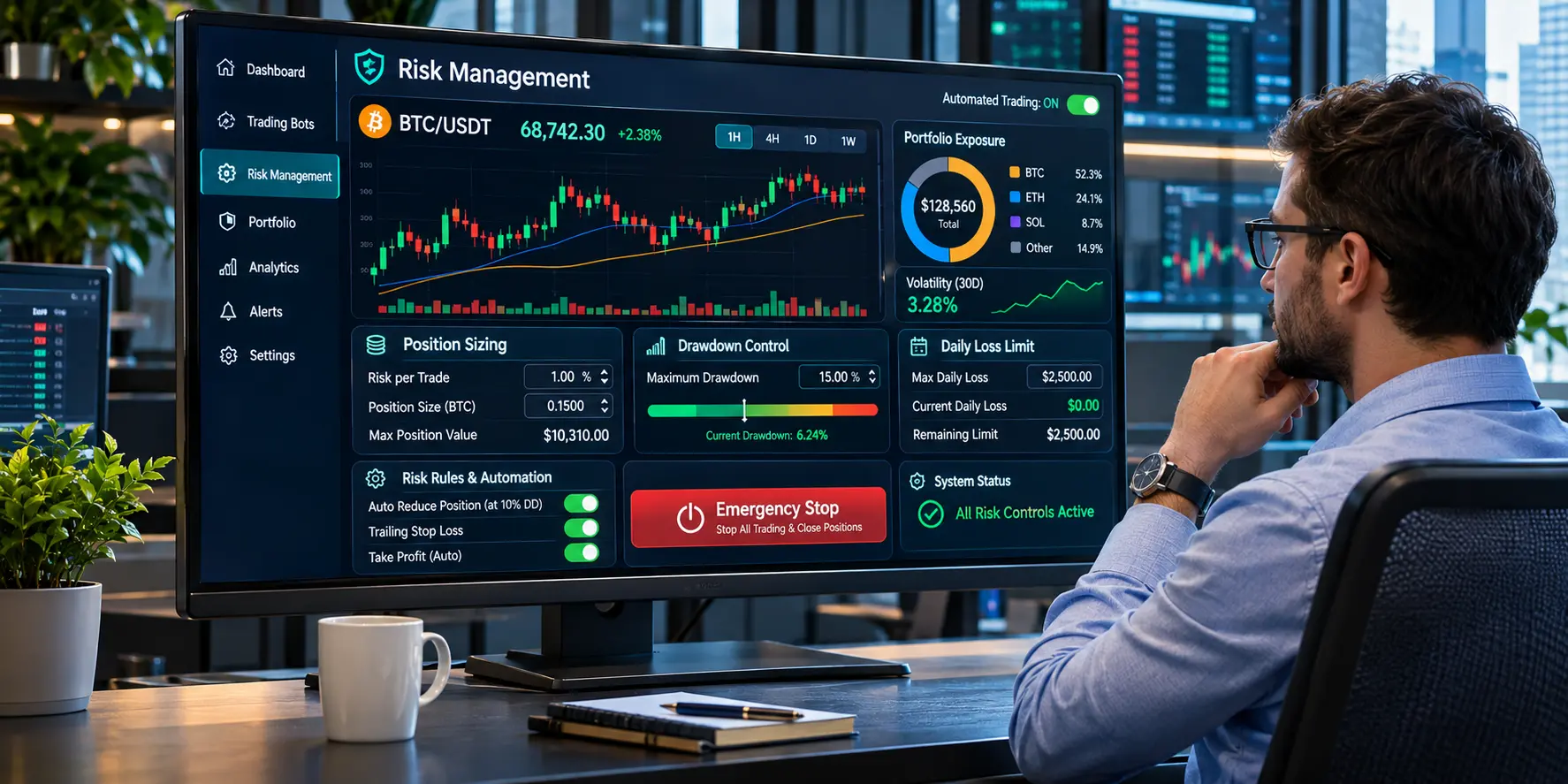
Automated trading risk management helps control how much capital a trading system can expose to market movements. Two important components are position sizing, which determines the amount allocated to individual trades, and drawdown limits, which restrict trading activity after losses reach predefined thresholds.
These controls are especially important for algorithmic and AI-powered trading systems because software can execute multiple transactions without requiring manual approval for every order.
Although automated risk controls cannot prevent all losses, they can help traders establish consistent boundaries around their strategies.
What Is Automated Trading Risk Management?
Automated trading risk management involves using software rules and monitoring systems to control financial exposure during trading activities.
Rather than relying entirely on manual decisions, automated platforms can evaluate predefined risk conditions before placing or maintaining trades.
Common risk-management functions include:
- Position-size restrictions.
- Maximum portfolio exposure.
- Stop-loss orders.
- Daily loss limits.
- Drawdown monitoring.
- Emergency trading suspension.
- Leverage and margin restrictions.
For example, a trading algorithm might identify a potential buying opportunity but reject the transaction because the portfolio has already reached its maximum permitted exposure.
This illustrates an important principle: a trading signal and permission to execute that signal are separate decisions.
Position Sizing in Automated Trading Risk Management
Position sizing determines how much capital a trading system allocates to a particular transaction.
It can be based on account value, risk tolerance, market volatility, or the distance between the entry price and a planned exit level.
Fixed Percentage Position Sizing
A straightforward approach allocates a fixed percentage of available capital to each position.
For example, consider a hypothetical trading account containing $10,000.
If the system limits each position to 5% of account value, the maximum initial allocation would be $500.
This approach helps prevent a single trade from consuming an excessive portion of the portfolio.
However, allocating 5% of capital to a position is not the same as risking only 5% of capital. Actual losses depend on price movements, leverage, and execution conditions.
Risk-Based Position Sizing
Risk-based sizing calculates position size using the maximum intended loss and the planned stop-loss distance.
A simplified formula is:
Position Size = Maximum Intended Trade Loss ÷ Stop-Loss Distance Per Unit
Suppose a trader is willing to risk $100 on a hypothetical transaction.
If the planned entry price is $50 and the stop-loss level is $48, the intended risk per unit is $2.
The calculated position size would be 50 units, assuming no leverage, fees, or slippage.
In real markets, stop-loss orders may execute at different prices. Therefore, the actual loss can exceed the intended amount.
Drawdown Limits in Automated Trading Risk Management
A drawdown measures the decline in account or portfolio value from a previous peak.
For example, if a trading account rises to $12,000 and subsequently falls to $10,800, the drawdown from that peak is 10%.
Automated trading systems can monitor drawdowns continuously and respond when predefined thresholds are reached.
Types of Drawdown Controls
Strategy drawdown limits: Restrict an individual trading strategy after significant losses.
Portfolio drawdown limits: Monitor losses across all active strategies and positions.
Daily loss limits: Restrict additional trading when losses exceed a specified amount during a trading session.
Maximum drawdown thresholds: Trigger predefined actions when the decline from a reference peak reaches a selected level.
These controls serve different purposes.
For example, a daily loss limit may prevent a system from opening additional positions after a difficult trading session.
A portfolio drawdown limit may address broader losses that accumulate over several days or weeks.
AI-Based Automated Trading Risk Management
AI-powered trading systems may combine market analysis with automated exposure management.
A model might identify favorable market conditions, while a separate risk-management component evaluates whether the proposed transaction fits the account’s limits.
For example, an AI system could generate a buying signal during increasing market volatility.
However, its risk controls might reduce the position size or reject the order if current exposure exceeds the configured threshold.
Investors researching AI trading software with risk management can examine Hyperlyx AI, which describes risk-control features alongside its multi-model trading intelligence architecture.
These descriptions illustrate the types of safeguards investors should investigate. However, users should verify which controls are currently operational, how they function, and whether they have undergone independent testing.
The presence of advertised risk-management features does not establish that a platform can prevent losses.
Stop-Loss Orders and Their Limitations
A stop-loss order is designed to initiate a transaction when an asset reaches a specified price.
Automated trading platforms may use stop-loss instructions to manage downside exposure.
However, a stop-loss price is not always the final execution price.
During rapid market movements, an order may execute at a less favorable price because of slippage.
Additionally, exchange outages, insufficient liquidity, and market gaps can interfere with execution.
Therefore, stop-loss orders should be treated as risk-management tools rather than guaranteed loss limits.
Why Emergency Stops Matter
An emergency stop allows a trading system to suspend activity when specified conditions occur.
Potential triggers include:
- Excessive portfolio losses.
- Unexpected order activity.
- Unusual market volatility.
- Exchange connectivity failures.
- Data-feed errors.
- Breaches of configured exposure limits.
An emergency stop may prevent new orders, cancel pending orders, or attempt to close positions, depending on the platform’s design.
However, stopping new transactions does not necessarily close existing positions.
Investors should understand exactly what happens when an emergency control activates.
Position Sizing vs. Drawdown Limits: Key Differences
Although both tools manage trading risk, they operate at different stages.
| Feature | Position Sizing | Drawdown Limits |
|---|---|---|
| Primary purpose | Control individual trade exposure | Restrict losses over time |
| Main measurement | Capital allocation or intended trade risk | Decline from a reference value |
| Typical application | Before order execution | During strategy or portfolio monitoring |
| Possible action | Reduce or reject an order | Pause, reduce, or stop trading |
| Main limitation | Cannot guarantee a maximum realized loss | Cannot reverse losses already incurred |
A robust trading framework may combine both controls rather than relying on either independently.
For example, position sizing can limit initial exposure while drawdown monitoring helps identify when a strategy should stop opening additional positions.
Can Automated Risk Controls Eliminate Trading Losses?
No. Automated risk controls can help manage exposure, but they cannot eliminate financial uncertainty.
Even carefully configured systems remain vulnerable to unexpected market movements, software errors, execution delays, and liquidity problems.
Furthermore, multiple positions may react to the same market event, creating larger combined losses than individual trade settings suggest.
Investors should also consider leverage, transaction costs, and the possibility that historical risk estimates may not reflect future conditions.
The effectiveness of automated risk management depends on realistic assumptions, reliable execution, and continuous oversight.
Conclusion
Automated trading risk management provides a structured way to control position exposure and respond to portfolio losses.
Position sizing helps determine how much capital a trading strategy can allocate, while drawdown limits establish boundaries for continued trading after unfavorable results.
When combined with stop-loss instructions, exposure monitoring, and emergency controls, these tools can support more disciplined automated trading.
However, no risk-management system can guarantee capital protection or profitable outcomes. Investors should understand the limitations of each safeguard and ensure that automated trading decisions remain consistent with their financial objectives and risk tolerance.