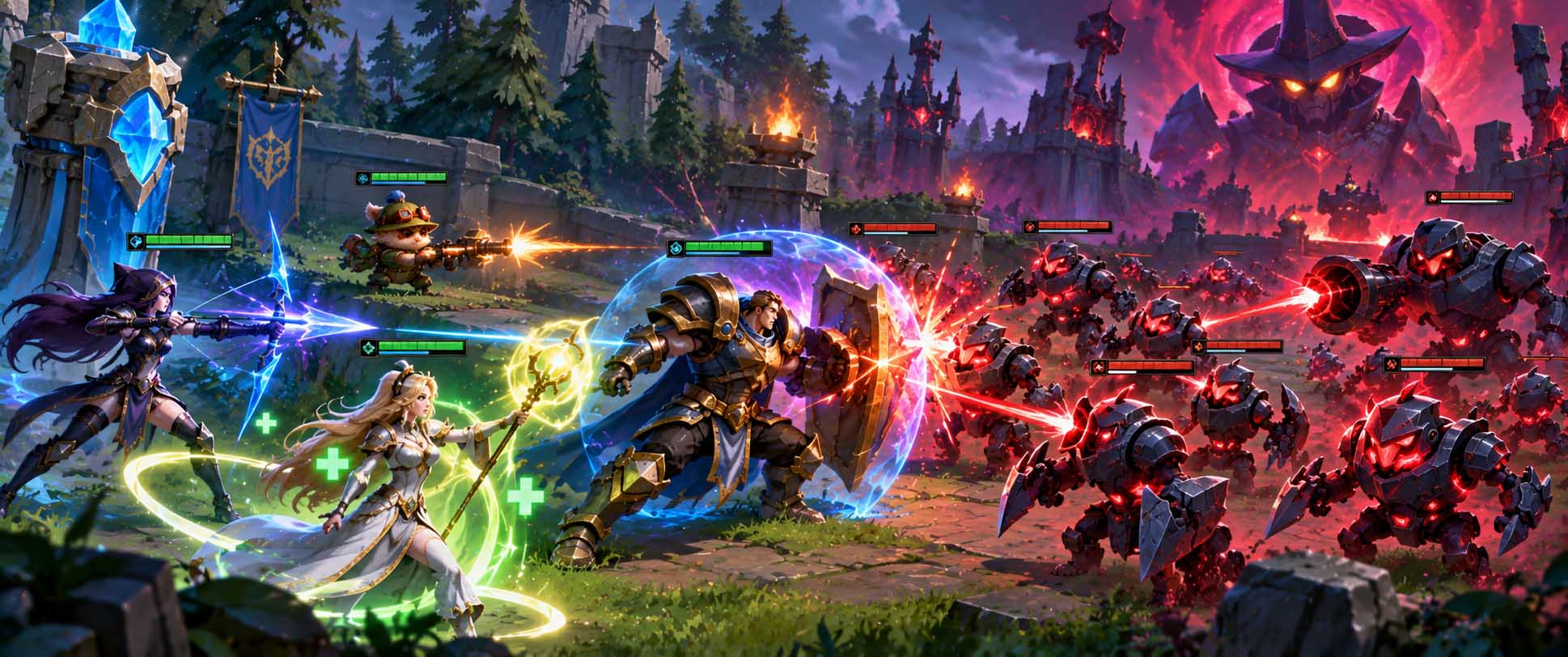
Strong sustain in Doom Bots helps champions remain useful through prolonged PvE pressure instead of depending entirely on short bursts of damage. Healing, shielding, durability, safe positioning, range, and defensive abilities can all improve survivability. The longer a champion stays active, the longer that champion can deal damage, control enemies, protect teammates, or clear incoming waves.
This makes survivability more than a defensive consideration. Staying alive also preserves the team’s offensive pressure and gives players more options as encounters become difficult.
What Does Sustain Mean in Doom Bots?
Sustain is a champion’s ability to remain effective over an extended period rather than quickly losing the resources or health needed to continue fighting.
Healing is one obvious form of sustain, but it is not the only one.
A champion may survive longer through shields, defensive abilities, durability, range, mobility, or crowd control. These tools reduce damage taken or create opportunities to avoid dangerous situations altogether.
For this reason, two champions can both have good survivability while achieving it in completely different ways.
A durable fighter may withstand direct pressure. A ranged champion may survive by keeping enemies at a distance. A utility champion can improve the survival of the entire group through protection.
Why Sustain in Doom Bots Is So Valuable
Doom Bots can create repeated pressure rather than presenting only one short fight.
When a champion loses too much health during every encounter, sustain in Doom Bots that pressure accumulates. Eventually, the player may be forced to retreat or become unable to take normal risks.
Sustain reduces this problem.
A champion capable of recovering health, absorbing damage efficiently, or avoiding unnecessary hits can continue contributing through multiple situations.
This consistency matters because every active champion represents something useful to the team. It might be wave clear, sustained damage, frontline presence, crowd control, or utility.
Keeping that function available can be more valuable than producing slightly more damage for a few seconds.
Survivability Is Not the Same as Being a Tank
A common mistake is to associate survivability only with champions that have large health pools or defensive builds.
Tanks and durable fighters certainly have advantages, but fragile champions can also survive effectively when their kits support safe play.
A ranged mage may rely on distance and crowd control.
A mobile damage dealer may avoid threats through repositioning.
A support-oriented champion can use shields or healing.
A fighter may combine durability with self-sustain.
Therefore, survivability should be evaluated according to how a champion actually remains active, not simply how much health the champion has.
The important question is whether the player has reliable tools for handling prolonged pressure.
Healing Helps Maintain Long-Term Fighting Power
Healing is one of the most direct forms of sustain.
When champions can recover some of the health lost during combat, mistakes and smaller instances of damage become less permanent. This can help them remain useful instead of gradually becoming too vulnerable to participate.
However, healing should not encourage careless play.
Taking avoidable damage simply because recovery is available wastes resources and can create unnecessary risk. Healing works best when combined with good positioning and sensible decision-making.
It acts as a safety mechanism rather than a replacement for avoiding danger.
Team-based healing can be particularly useful because it improves the staying power of several champions instead of helping only one player.
Shields Prevent Damage Before It Becomes a Problem
Healing restores health after damage occurs. Shields work differently by absorbing some incoming damage before it reduces health.
This distinction can matter when a player expects a dangerous moment.
A well-timed shield may allow a damage dealer to remain active instead of immediately retreating. It can also protect a frontline champion while that player creates space for the rest of the team.
Shields are especially useful when combined with other forms of survivability.
A champion protected by good positioning, crowd control, and shielding may remain safe without requiring extreme base durability.
This demonstrates why team utility can influence individual survivability.
Frontline Durability Protects More Than One Champion
A durable frontline does not help only itself.
When a frontline champion occupies dangerous space, ranged allies can often operate from safer positions. The frontline absorbs attention and creates distance between threats and vulnerable teammates.
This makes frontline durability a team resource.
A fighter that survives for longer may give a ranged damage dealer more time to attack. It may also allow a control mage to use abilities from a safer location.
The relationship works in both directions. Ranged damage and crowd control can reduce the amount of pressure the frontline needs to withstand.
Strong teams combine these strengths instead of expecting one durable champion to handle everything alone.
Survivability Should Influence Champion Selection
Damage is naturally important when choosing a champion, but damage potential should not be evaluated in isolation.
A champion with excellent theoretical output may provide less practical value if it repeatedly becomes unable to fight under sustained pressure.
Meanwhile, a slightly less explosive champion with dependable sustain or defensive tools may contribute more consistently.
When evaluating different picks, a broader Doom Bots strategy guide can help players compare champion qualities such as wave clear, damage, control, and survivability rather than judging choices through raw damage alone.
The goal is not to select five defensive champions. It is to make sure the composition has enough staying power to keep its important roles functioning.
Positioning Is a Form of Survivability
Not every defensive advantage appears on a champion’s statistics.
Positioning is one of the most important examples.
A ranged champion that maintains proper distance may avoid damage that a poorly positioned player would need to heal afterward. Similarly, a melee champion can reduce unnecessary damage by entering and leaving dangerous areas at appropriate times.
Good positioning also helps players preserve defensive abilities for moments when they are genuinely needed.
Instead of constantly recovering from mistakes, the team prevents some of those mistakes from becoming costly in the first place.
This makes positioning a form of practical sustain.
Crowd Control Can Reduce Incoming Pressure
Crowd control also contributes indirectly to survival.
A rooted, stunned, slowed, or otherwise controlled enemy has fewer opportunities to apply pressure freely. This can give teammates time to reposition, attack safely, or create additional distance.
Control is especially useful when the team needs to protect a vulnerable damage dealer.
Rather than relying entirely on shields or healing after the enemy reaches that champion, crowd control can prevent or delay the threat.
This is another reason survivability should be viewed as a team concept.
Sometimes the best defensive tool is not additional health. It is preventing an enemy from creating the dangerous situation in the first place.
Balance Sustain With Damage and Wave Clear
Too little survivability can make a team fragile, but too much defensive emphasis creates a different problem.
Doom Bots still requires teams to remove waves, damage dangerous enemies, and progress through encounters. A composition that survives comfortably but cannot apply enough pressure may struggle for a different reason.
The goal is balance.
Durable champions should create opportunities for damage dealers. Utility champions should help the team remain active. Damage-focused champions should take advantage of the protection provided to them.
Ideally, some champions can perform multiple jobs.
A durable fighter may provide frontline pressure and damage. A utility champion may combine shields with crowd control. A ranged mage may offer wave clear while using distance as a defensive advantage.
These overlaps make the overall composition more efficient.
Sustain Matters More During Extended Pressure
Short encounters can sometimes be solved through burst damage before survivability becomes a major issue.
Extended pressure exposes weaknesses more clearly.
As fights continue, champions that cannot recover, avoid damage, or withstand pressure have fewer opportunities to contribute safely. Those with dependable sustain can remain active for longer.
This becomes especially relevant when teams need to preserve enough strength for later challenges rather than spending every defensive resource immediately.
Players should therefore think beyond the current enemy wave. Good survival decisions help maintain readiness for whatever comes next.
Staying Alive Keeps the Entire Team Functional
Sustain in Doom Bots matters because every surviving champion keeps an important part of the team available.
Frontline champions continue creating space. Damage dealers continue applying pressure. Control champions keep dangerous enemies manageable, while utility picks can continue protecting their teammates.
Healing and shields are valuable, but survivability also comes from durability, positioning, range, mobility, and crowd control. The strongest approach combines several of these tools rather than depending on only one.
A team that balances survivability with damage, wave clear, and utility is better prepared for prolonged PvE pressure because its champions can continue performing their roles when encounters become more demanding.