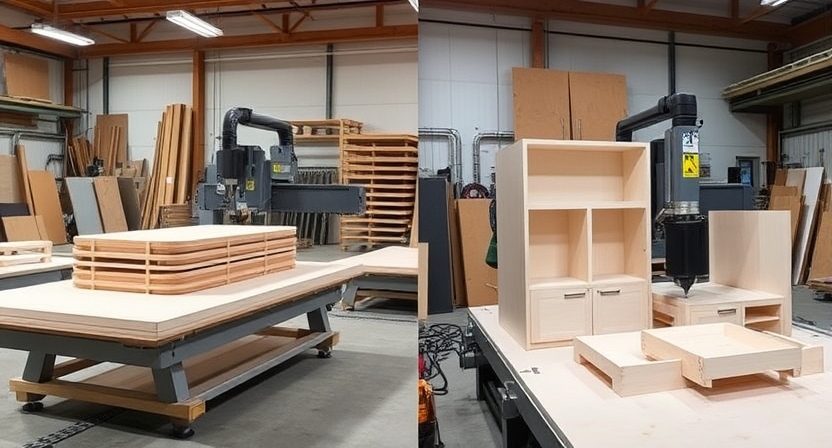
The main difference in a panel saw vs nesting CNC workflow is how sheet materials are converted into furniture components. A panel saw primarily divides panels into accurately sized pieces through straight cuts, while a nesting CNC can arrange multiple components within a sheet and machine their shapes according to digital tool paths.
Both methods can support furniture and cabinet production. However, they organize panel processing differently, which affects material flow, downstream machining, component variety, and the type of production system a factory may need.
What Is a Panel Saw Workflow?
A panel saw is designed primarily for cutting sheet materials into required dimensions.
Furniture factories commonly process materials such as MDF, particleboard, plywood, laminated board, and other wood-based panels. A panel saw makes straight cuts that divide these larger sheets into individual components.
Depending on production requirements, manufacturers may use equipment such as sliding table saws or beam saws.
A simplified panel-saw workflow can look like this:
Full sheet → cutting plan → panel saw → sized components → edge banding → drilling → assembly
In this arrangement, cutting and drilling usually remain separate operations.
The saw establishes the component’s dimensions, while other machines create holes, grooves, hardware locations, and additional features later in production.
How Does a Nesting CNC Workflow Work?
Nesting CNC takes a more digitally integrated approach to panel processing.
Nesting software positions multiple component shapes within the usable area of a sheet. The CNC machine then follows programmed tool paths to produce those parts.
Depending on the machine, software, and tooling, a nesting process may combine several operations, including:
- Component cutting
- Routing
- Grooving
- Pocketing
- Shaped machining
- Selected drilling operations
The workflow may therefore look like:
Digital component data → nesting layout → CNC machining → labeled components → edge processing or additional drilling → assembly
This approach can be particularly useful when furniture components vary significantly in size or shape.
Panel Saw vs Nesting CNC for Cutting Patterns
The geometry of the required components is an important difference between the two methods.
Panel saws are particularly suited to straight cutting. Cabinet sides, shelves, partitions, and other rectangular components can be produced efficiently from sheet material using an appropriate cutting plan.
Nesting CNC equipment is not limited to the same straight-cut workflow.
A CNC router follows programmed tool paths, allowing it to create shaped components, internal cutouts, grooves, and other features that may require separate processes in a conventional saw-based system.
This flexibility can matter when a factory produces customized furniture or components with non-standard geometry.
How Does Sheet Optimization Differ?
Both workflows can aim to use panel material efficiently, but they approach the problem differently.
In a panel-saw workflow, cutting optimization typically determines how rectangular parts should be divided from the sheet using straight cuts. The cutting sequence needs to work with the saw’s operating method.
Nesting software can position differently sized or shaped parts across the sheet according to the machining strategy.
However, material utilization should not be judged by software layout alone. Tool diameter, spacing between parts, component orientation, material characteristics, edge requirements, and handling considerations can all influence the practical result.
The most suitable approach therefore depends on the parts being produced rather than simply choosing whichever layout appears to contain more components.
Panel Processing Machinery Should Fit the Complete Factory
The cutting stage is only one part of furniture manufacturing.
After components leave a panel saw or nesting system, they may still need edge banding, drilling, boring, sanding, labeling, sorting, and assembly.
When evaluating panel processing machinery, manufacturers should consider how the selected cutting method connects with these downstream operations. A fast cutting process provides limited benefit if components consistently wait for edge processing or drilling.
A factory should therefore compare complete workflows rather than only the specifications of the panel saw or CNC machine.
Which Method Works Better With Drilling?
A conventional panel-saw workflow generally treats drilling as a separate production stage.
After components are cut, they move to multi-boring or CNC drilling equipment for hinge holes, shelf-support holes, dowels, connectors, and other hardware locations.
A nesting CNC may perform selected drilling operations while the component remains on the machine.
Whether this reduces later drilling depends on the component design and machine configuration. Some parts may still require edge drilling or machining on faces that are not accessible during the nesting operation.
Therefore, factories should map every required hole before deciding how much drilling can realistically be integrated into the initial panel-processing stage.
Production Volume and Product Variety Matter
Production volume alone does not determine whether a panel saw or nesting CNC is more appropriate.
The type of production also matters.
A factory producing large batches of rectangular components may benefit from a structured saw-based workflow. A manufacturer producing customized cabinets with frequent dimensional changes may value the digital flexibility of nesting.
Product variety also affects setup requirements.
When component dimensions change frequently, digital CNC programs can help manage variation. In contrast, repetitive standardized cutting may align naturally with an optimized panel-saw process.
Factories should examine both the number of parts being produced and how often those parts change.
What About Component Identification?
Component tracking becomes increasingly important as production becomes more complex.
After a full sheet has been divided into many similar-looking panels, workers need to know which component belongs to which cabinet, order, or downstream machining operation.
Labels can carry information such as component identity, order details, dimensions, edge requirements, or subsequent processing instructions.
Both panel-saw and nesting workflows can benefit from organized labeling.
This is especially important in custom furniture manufacturing, where components from different orders may move through the factory at the same time.
Good identification helps connect panel processing with edge banding, drilling, sorting, and assembly.
Does Nesting CNC Automatically Mean More Automation?
Not necessarily.
A nesting CNC provides computer-controlled machining, but the overall production line may still require manual panel loading, component unloading, labeling, sorting, edge processing, and material movement.
Likewise, a panel-saw workflow can incorporate automated loading, cutting optimization, labeling, conveyors, or other material-handling systems.
Automation should therefore be evaluated at the workflow level.
A factory needs to identify where manual handling occurs, where components wait, and which stages create production constraints. The machine used to cut the sheet is only one element of that system.
How Should a Furniture Factory Choose?
The choice should begin with actual component requirements.
A manufacturer can compare the two approaches by asking:
- Are most components rectangular or irregularly shaped?
- Which panel materials are processed?
- How frequently do component dimensions change?
- Are grooves or routed features required?
- Can drilling be integrated into CNC processing?
- What happens to components after cutting?
- How are parts labeled and tracked?
- What production volume is expected?
- Where are current workflow bottlenecks?
These questions provide more useful guidance than comparing machine speed alone.
Choosing the Right Panel Processing Workflow
Panel saws and nesting CNC systems can both play important roles in furniture manufacturing, but they organize production differently.
A panel saw provides a direct method for producing accurately sized components through straight cutting and can integrate well with separate drilling and edge-processing stages. Nesting CNC connects digital layouts with programmable machining and can handle more varied component geometry while combining selected operations.
The better workflow depends on the factory’s materials, product designs, component variety, downstream machinery, and production structure. By evaluating the complete path from full sheet to assembly-ready part, manufacturers can select a panel-processing method that supports the way their furniture is actually produced.